
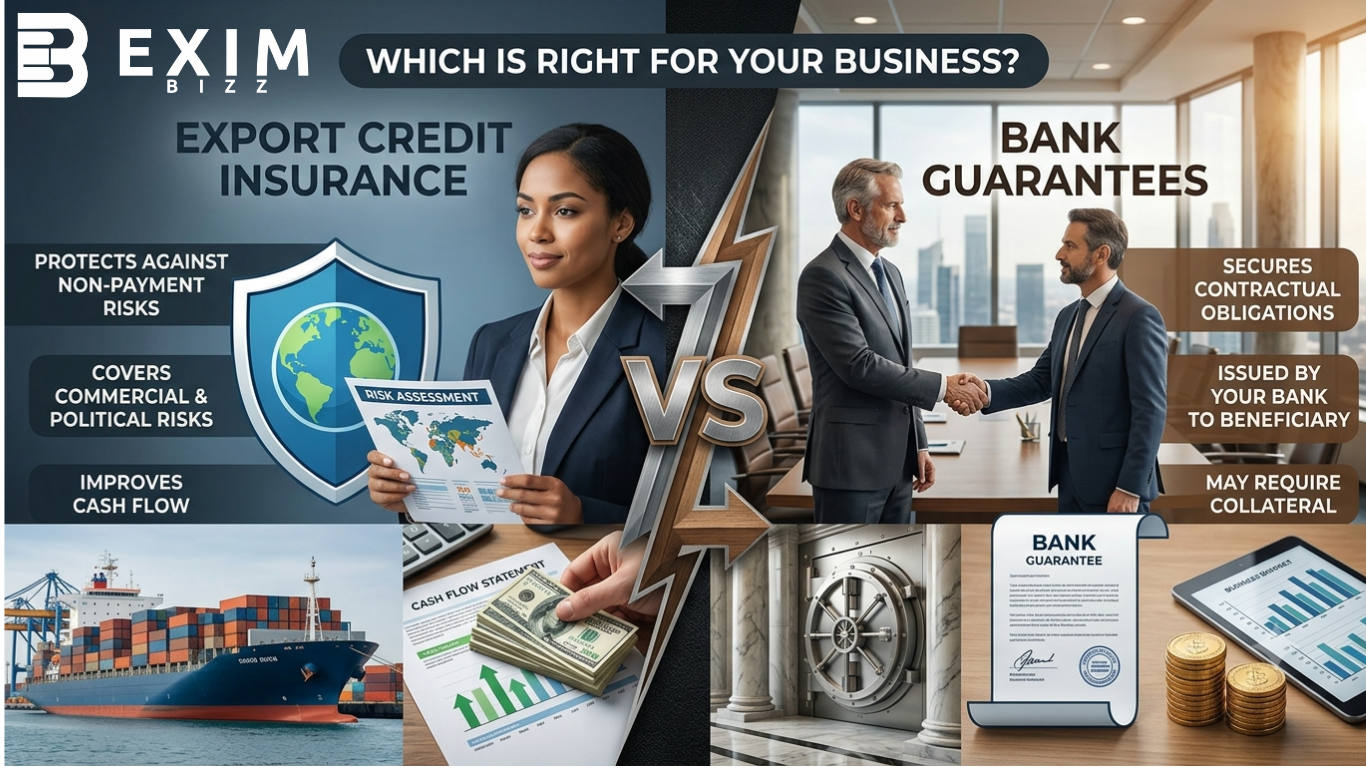
1. Export Credit Insurance (ECI): The Safety Net for Open Account Trade
Export Credit Insurance is a policy taken out by the exporter to protect against the risk of non-payment by the overseas buyer. In India, this is primarily provided by the ECGC (Export Credit Guarantee Corporation of India), while globally, it’s offered by private insurers like Euler Hermes or Atradius.
How it Works:
You pay a premium (usually a small percentage of the invoice value). If your buyer fails to pay due to commercial or political reasons, the insurance company compensates you for the loss (typically up to 80-90% of the invoice value).
What it Covers:
- Commercial Risks: Buyer bankruptcy, insolvency, or protracted default (delaying payment beyond the agreed terms).
- Political Risks: In some situations such as War, civil unrest, government import bans, or foreign exchange restrictions in the buyer’s country that prevent them from transferring the money.
The Biggest Advantage:
It allows you to offer “Open Account” terms. Instead of asking for advance payment (which buyers hate), you can offer 30, 60, or 90-day credit terms. This makes you highly competitive and helps you win more contracts. Furthermore, banks love ECI policies and will often give you better working capital loans against insured receivables.
2. Bank Guarantees (BG) & Standby Letters of Credit (SBLC): The Promise that bears no risk
A Bank Guarantee (or SBLC) is a financial instrument issued by the buyer’s bank. It acts as a strict promise from the bank that if the buyer fails to pay you, the bank will pay you on their behalf.
How it Works:
The buyer approaches their bank and requests a guarantee in your favor. The bank blocks the buyer’s funds or uses their credit line to issue the BG/SBLC. If the buyer defaults on payment, you simply present the default claim to the bank, and the bank releases the funds to you.
What it Covers:
- Payment Default: It guarantees the financial obligation of the buyer. If they don’t pay, the bank does.
- Note: Standard bank guarantees generally do not cover political risks (like a government freezing funds) unless specifically structured as a risk-participation agreement.
The Biggest Advantage:
Absolute payment security. Because a top-tier global bank is backing the payment, your risk is virtually zero, provided you meet the documentary conditions. It is highly preferred for massive, one-off capital goods shipments or large project exports.
3. Head-to-Head Comparison
|
Feature
|
Export Credit Insurance (ECI)
|
Bank Guarantee / SBLC
|
|---|---|---|
|
Who gets it?
|
The Exporter (Seller)
|
The Importer (Buyer) issues it to the Exporter
|
|
Primary Risk Covered
|
Commercial & Political Risks
|
Commercial Risk (Payment Default)
|
|
Cost/Burden
|
Exporter pays a small premium
|
Buyer pays bank fees (often passed to exporter in price)
|
|
Impact on Sales
|
High (Allows offering credit/Open Account terms)
|
Low (Requires buyer to lock up bank credit)
|
|
Best Used For
|
Regular, recurring shipments, FMCG, textiles, SMEs
|
High-value, one-off shipments, capital goods, machinery
|
|
Claims Process
|
Requires proving the default and waiting periods
|
Immediate payment upon presentation of compliant documents
|
4. How to Choose: Which is Right for Your Business?
The right choice depends on your product, your buyer, and your business model.
Choose Export Credit Insurance (ECI) If:
- You are an SME exporting consumer goods, textiles, or agriculture: You need to offer 30-to-90-day credit terms to survive and compete.
- You are exporting to emerging or volatile markets: You need protection against political risks, currency blockages, or country-specific crises.
- You want to boost your working capital: You can use the ECI policy to get cheap “Packing Credit” or post-shipment finance from your bank.
- You have many small buyers: It is impossible to ask 50 small buyers to open Bank Guarantees. ECI allows you to insure all of them under one umbrella.
Choose Bank Guarantees / SBLC If:
- You are exporting high-value capital goods or machinery: If a single shipment is worth millions of dollars, the premium for ECI might be too high, and you need the ironclad security of a top-tier bank.
- Your buyer is a massive multinational: Large corporations have excellent banking relationships and can easily issue SBLCs without disrupting their cash flow.
- It is a one-off transaction: If you don’t have a continuous relationship with the buyer and don’t want to set up a long-term insurance policy.
- The buyer’s country has high political risk, but their bank is global: If the buyer is in a risky country but uses a top-tier international bank (like HSBC, Citi, or Standard Chartered) to issue the BG, the bank’s creditworthiness overrides the country risk.
5. The Ultimate Strategy: Why Not Both?
The most sophisticated exporters don’t choose between the two; they use them together.
For example, you can use Export Credit Insurance to cover your day-to-day shipments on open account terms. But for the 10% “self-retained” risk (since ECGC usually covers 90%), or for your absolute largest buyers, you can ask for a Standby Letter of Credit (SBLC).
Additionally, many banks will issue a “Finance against Bank Guarantee” or use your ECI policy to issue a bank guarantee on your behalf, creating a seamless loop of financial security.
The Bottom Line
Securing your export payments is not just about protecting your money; it is about giving yourself the financial confidence to scale globally. Export Credit Insurance gives you the agility to offer competitive credit terms, while Bank Guarantees provide the heavy-duty armor for massive deals.
Evaluate your buyer’s profile, understand your risk appetite, and choose the instrument that keeps your cash flow flowing.
Need expert guidance on securing your international payments, understanding ECGC policies, or negotiating SBLC terms? At Eximbizz, we provide end-to-end export-import consultancy to ensure your business grows safely and profitably. [Contact Rohit and the Eximbizz team today] (https://eximbizz.com/contact/) to secure your next global contract!