
You have a fantastic product, a highly competitive price, and a flawless export strategy. Yet, your international deal falls through at the last minute.
What went wrong?
In international trade, having a great product is only 50% of the equation. The other 50% is Cultural Intelligence (CQ). The way you negotiate in Dubai will likely fail in Frankfurt, and the tactics that work in Tokyo will confuse buyers in London.
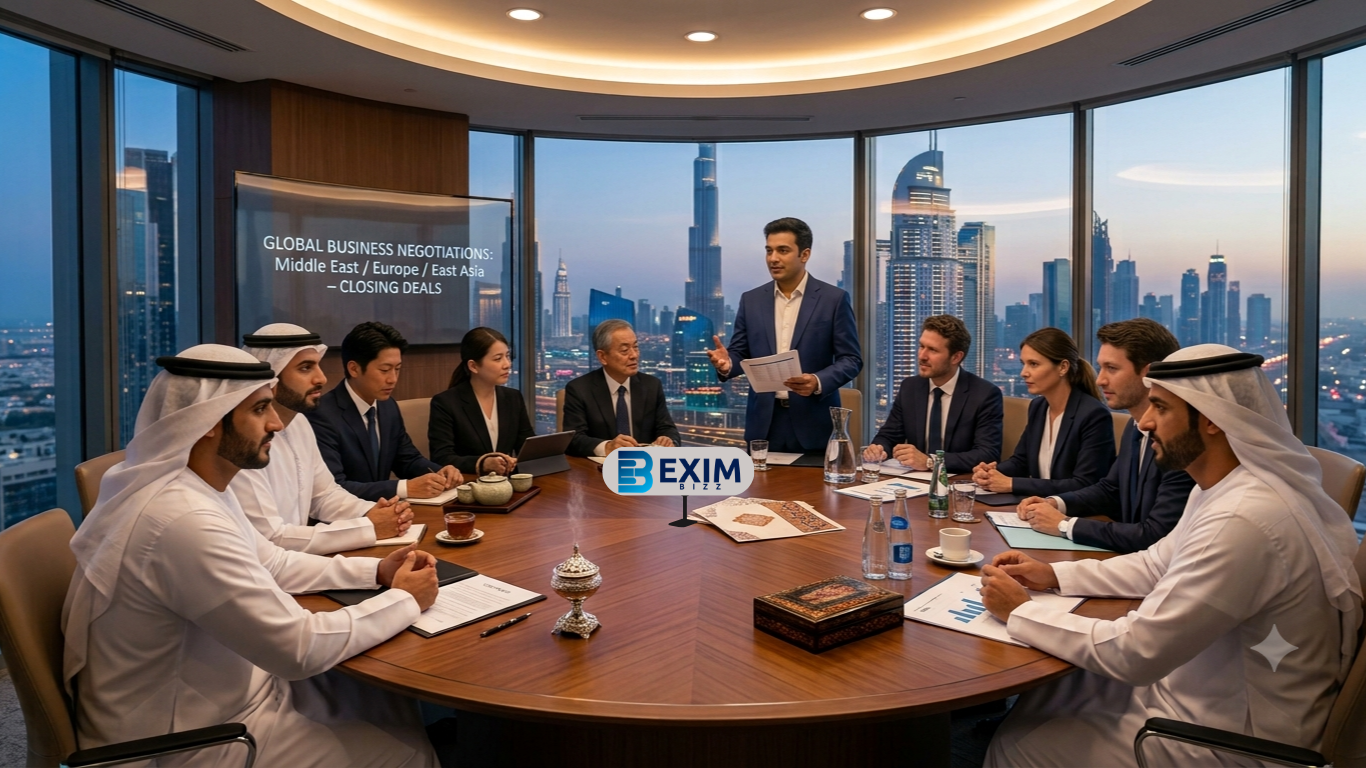
To scale your Exim business globally, you must adapt your communication, pacing, and negotiation style to match the cultural expectations of your buyer. Here is your master guide to closing deals across three major global markets.
1. The Middle East: Trust, Relationships, and the Art of Patience
In the Middle East (particularly the GCC countries like UAE, Saudi Arabia, and Qatar), business is deeply personal. You are not just selling to a company; you are doing business with an individual.
The Cultural Nuances:
- Time is Fluid: Punctuality is expected from you, but do not be offended if your counterpart is late or if meetings run long. Time is viewed as a flexible construct.
- Relationships First, Business Second: Trust is the ultimate currency. If you rush into talking about prices and contracts in the first five minutes, you will lose their respect.
Winning Tactics for the Middle East:
- Invest in Small Talk: Always accept offers of coffee or tea. Ask about their health, their family (though avoid asking specifically about female family members unless they bring it up), and their recent travels. Building rapport is not a distraction; it is the negotiation.
- Read Between the Lines of “Yes”: In many Middle Eastern cultures, directly saying “no” is considered impolite. A “yes” or “Inshallah” (God willing) might just mean “I hear you,” not “I agree to the price.” Look for body language and actual commitment rather than just verbal agreement.
- Respect Hierarchy and Age: Decisions are made at the top. Always address the most senior person in the room first, and show visible respect to older individuals.
- Expect the Haggle: Negotiating price is expected. If you give your “best and final” price too early, they will assume you are hiding a margin. Build in a little room to negotiate, and make them feel like they won a concession.
2. Europe: Logic, Data, and Direct Communication
Europe is diverse, but when it comes to B2B trade—especially in Northern and Western Europe (Germany, UK, Netherlands, Scandinavia)—business is highly structured, efficient, and data-driven. (Note: Southern Europe like Italy and Spain leans slightly more toward relationship-building, but still values structure).
The Cultural Nuances:
- Time is Money: Punctuality is non-negotiable. Being even five minutes late to a meeting in Germany or Switzerland is a sign of deep disrespect.
- Directness is Appreciated: Small talk is kept brief. Buyers want to get straight to the facts, the specs, and the bottom line.
Winning Tactics for Europe:
- Bring the Data, Leave the Fluff: European buyers are highly analytical. Do not rely on emotional sales pitches. Bring detailed product specifications, compliance certificates (like CE marking), sustainability reports, and clear pricing breakdowns.
- Be Direct and Transparent: If you cannot meet a deadline or a price point, say so clearly and professionally. Beating around the bush will be viewed as evasive or untrustworthy.
- The Contract is King: Once the contract is signed, it is final. Unlike in some regions where a signed contract is just the “start of the negotiation,” in Europe, the contract is the absolute rulebook. Ensure every detail is perfect before signing.
- Keep it Professional: Avoid overly aggressive sales tactics, exaggerated claims, or trying to become “best friends” too quickly. Professional respect is the foundation of European business.
3. East Asia: Harmony, “Face”, and Long-Term Vision
Doing business in East Asia (China, Japan, South Korea) requires a high degree of emotional intelligence. The focus is on group harmony, long-term partnerships, and indirect communication.
The Cultural Nuances:
- The Concept of “Face” (Mianzi): “Face” represents a person’s reputation, dignity, and prestige. Causing someone to lose face (by embarrassing them, contradicting them publicly, or being overly aggressive) will instantly kill a deal.
- Consensus over Individualism: Decisions are rarely made by one person on the spot. They are made by group consensus behind closed doors.
Winning Tactics for East Asia:
- Master Indirect Communication: A direct “no” is rarely used. If a buyer says, “We will study this,” “That is difficult,” or simply sucks air through their teeth, it means no. Learn to read the silence and the subtle cues.
- Protect Their “Face”: Never aggressively point out a mistake your counterpart made in front of their team. If there is a discrepancy in pricing or specs, address it privately or frame it as a “mutual misunderstanding.”
- The Boardroom vs. The Banquet: The formal meeting is for showing respect and exchanging information. The real relationship building, and often the real deal-breaking, happens at the dinner table or the banquet. Accept all invitations to dine, understand the seating hierarchy, and learn the local toasting etiquette (e.g., Ganbei in China, Geonbae in Korea).
- Play the Long Game: Do not try to close a massive deal on your first trip. The first visit is strictly to introduce your company, build trust, and show your long-term commitment to their market. The contract will come on the third or fourth visit.
4. Quick Cheat Sheet: Global Negotiation Styles
|
Feature
|
The Middle East
|
Europe (North/West)
|
East Asia
|
|---|---|---|---|
|
Core Focus
|
Relationships & Trust
|
Logic, Data & Efficiency
|
Harmony, Face & Consensus
|
|
Communication
|
Indirect, expressive
|
Direct, explicit
|
Highly indirect, subtle
|
|
View of Time
|
Flexible, fluid
|
Strict, punctual
|
Punctual, but patient
|
|
The “No”
|
“Inshallah” / “We will see”
|
A direct “No”
|
“We will study it” / Silence
|
|
Deal Closing
|
After deep personal trust
|
After contract review
|
After long-term relationship
|
The Bottom Line
In the export-import business, your product gets you a meeting, but your cultural intelligence gets you the contract.
By adapting your negotiation style—whether it’s sharing tea in Dubai, presenting hard data in Frankfurt, or navigating a banquet in Shanghai—you show your overseas buyers that you respect their culture. And in global trade, respect translates directly to revenue.