

You’ve manufactured the goods, cleared customs, and your cargo is on the water. But weeks turn into months, and your overseas buyer is making excuses for delayed payment.
Suddenly, your bank’s Authorized Dealer (AD) branch calls you. They are asking about “pending EDPMS entries” and warning you about “FEMA compliance.”
Managing delayed export payments is one of the most stressful aspects of the international trade business. But more importantly, under Indian law, delayed payment isn’t just a cash-flow problem—it is a regulatory compliance issue.
To protect your business from severe financial penalties, frozen bank accounts, and blocked AD Codes, every Indian exporter must master the rules of EDPMS and FEMA. Here is your comprehensive guide to understanding the regulations and keeping your export operations 100% compliant.
1. What is EDPMS and Why Does the RBI Care?
First, let’s clear up the terminology.
- FEMA (Foreign Exchange Management Act) is the actual law that governs all foreign exchange transactions in India.
- EDPMS (Export Data Processing and Monitoring System) is the IT platform used by the Reserve Bank of India (RBI) to enforce that law.
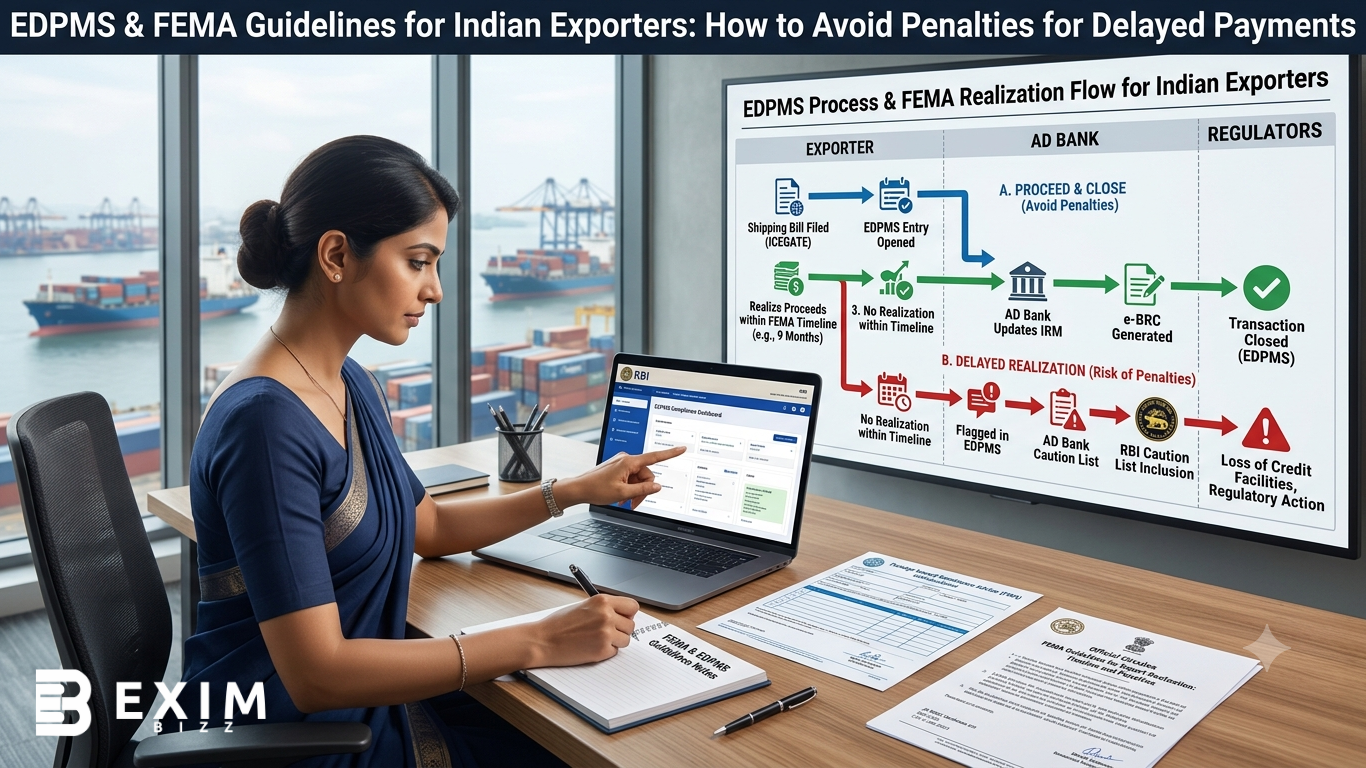
When your Customs House Agent (CHA) files a Shipping Bill, the data is instantly shared with the RBI’s EDPMS portal. The RBI now knows exactly what you exported, the value, and to whom.
The RBI’s primary mandate is to ensure that the foreign exchange earned by Indian exporters actually flows back into the country to strengthen India’s foreign exchange reserves. EDPMS is the dashboard the RBI uses to track whether the payment for every single Shipping Bill has been realized (received) and repatriated to India.
2. The Golden Rule: The 9-Month Realization Timeline
Under the Foreign Exchange Management (Export of Goods and Services) Regulations, there is a strict deadline for bringing your export money back to India.
The Standard Rule: The full export value of the shipment must be realized and repatriated to India within 9 months from the date of export (the date the Let Export Order is passed).
(Note: For certain specific goods or under specific government approvals, this can sometimes be extended, but 9 months is the golden rule you must operate by).
If the payment is not received and credited to your AD bank within this 9-month window, your EDPMS entry turns “red.” It becomes an “overdue” or “pending” entry, triggering a cascade of compliance alarms.
3. What Happens When You Default? (The Penalties)
Many exporters think, “It’s just a delayed payment, the buyer will pay eventually.” Under FEMA, the RBI does not care about the buyer’s excuses; they only care about your compliance.
If you fail to realize payment within the stipulated time, you face severe consequences:
- AD Code Blocking: Your AD bank is legally obligated to report you to the RBI. The bank can restrict or completely block your AD Code, meaning you cannot export any new goods until the old pending payments are cleared.
- Caution List: The RBI can place your company on the “Caution List.” Once on this list, all your future exports must be routed on a “Prior Approval” basis, making international trade practically impossible.
- Heavy Financial Penalties: Under Section 13 of FEMA, the Directorate of Enforcement (ED) can impose penalties up to three times the amount involved in the contravention.
- Loss of Export Incentives: You may be barred from claiming benefits under DGFT schemes like RoDTEP or Advance Authorization if you have pending FEMA violations.
4. Step-by-Step Guide to Avoiding Penalties & Managing Delays
You don’t have control over your buyer’s cash flow, but you do have control over your compliance. Here is exactly how to manage delayed payments without attracting the wrath of the RBI.
Step 1: Build a “Time is of the Essence” Payment Clause
Prevention is better than cure. Your Commercial Invoice and Export Contract must have strict payment terms. Include a clause stating that interest will be charged on delayed payments. More importantly, if you are offering credit terms (e.g., Net 60), ensure it is well within the 9-month FEMA realization limit.
Step 2: Utilize ECGC Cover (The Ultimate Shield)
This is the most powerful tool in an exporter’s arsenal. If you have insured your export invoice with the Export Credit Guarantee Corporation of India (ECGC), the RBI views the payment as “secured.” If the buyer defaults and the payment is delayed beyond 9 months, the ECGC policy covers the loss. Under FEMA guidelines, if an export is covered by ECGC, the AD bank can regularize the EDPMS entry based on the ECGC claim settlement, protecting you from penalties. Never offer open-account credit to a new buyer without ECGC cover.
Step 3: Apply for a Time Extension with Your AD Bank
If you know the buyer is going to delay payment beyond the 9-month mark, do not wait for the deadline to pass. Approach your AD bank before the 9 months expire and apply for an extension of the realization period.
- What you need: You must provide solid proof. This includes email correspondences from the buyer explaining the delay, a revised payment schedule, or an amended Letter of Credit (LC).
- The Process: AD banks have delegated powers from the RBI to grant extensions on a case-by-case basis if they are satisfied with the genuine nature of the delay.
Step 4: Write-Off Small Unrealized Amounts
Sometimes, a buyer pays 95% of the invoice, and the remaining 5% is stuck in dispute, or bank charges eat into the realization. Under FEMA guidelines, AD banks are permitted to write off unrealized export proceeds up to a certain limit (typically up to 5% of the total export value during the previous calendar year, or specific small ticket amounts as per the latest RBI Master Directions). If the unpaid amount falls within this threshold, you can submit a written request to your AD bank to write off the amount and close the EDPMS entry, preventing it from becoming a penal offense.
Step 5: Weekly EDPMS Reconciliation (The BRC/FIRC Process)
The most common reason for “fake” delays is poor internal accounting. The money might have hit your bank, but the EDPMS portal doesn’t know about it.
- When foreign currency hits your account, your bank issues a FIRC (Foreign Inward Remittance Certificate) or an FIRA (Foreign Inward Remittance Advice).
- You must immediately submit the FIRC/FIRA to your bank along with the corresponding Shipping Bill details.
- The bank will then issue a BRC (Bank Realization Certificate) and digitally upload the realization data to the EDPMS portal, “knocking off” the pending entry.
- Action Item: Sit with your bank’s forex desk every Friday to ensure all realized payments have been mapped to their correct Shipping Bills on the EDPMS portal.
Things to Remember
In the eyes of the RBI and FEMA, an export is not complete when the ship sails. The export is only complete when the foreign exchange hits your bank account and is digitally recorded on the EDPMS portal.
By understanding the 9-month rule, leveraging ECGC insurance, proactively applying for extensions, and maintaining strict weekly reconciliation with your AD bank, you can completely insulate your business from regulatory penalties.
Protect your cash flow, but more importantly, protect your compliance.