
Top 5 Reasons Indian Export Shipments Get Detained at Customs (And How to Prevent Them)
There is no feeling worse in the export-import business than tracking your cargo and seeing the status: “Detained by Customs.”
Every hour your container sits at the port—whether it’s Nhava Sheva, Mundra, or Chennai—it is bleeding money. You are racking up Terminal Handling Charges (THC), demurrage, and detention penalties. Worse, your buyer is losing faith in your reliability.
Indian Customs (CBIC) is highly efficient, but it is also incredibly strict. A single minor oversight can trigger a physical examination and halt your shipment for days or even weeks.
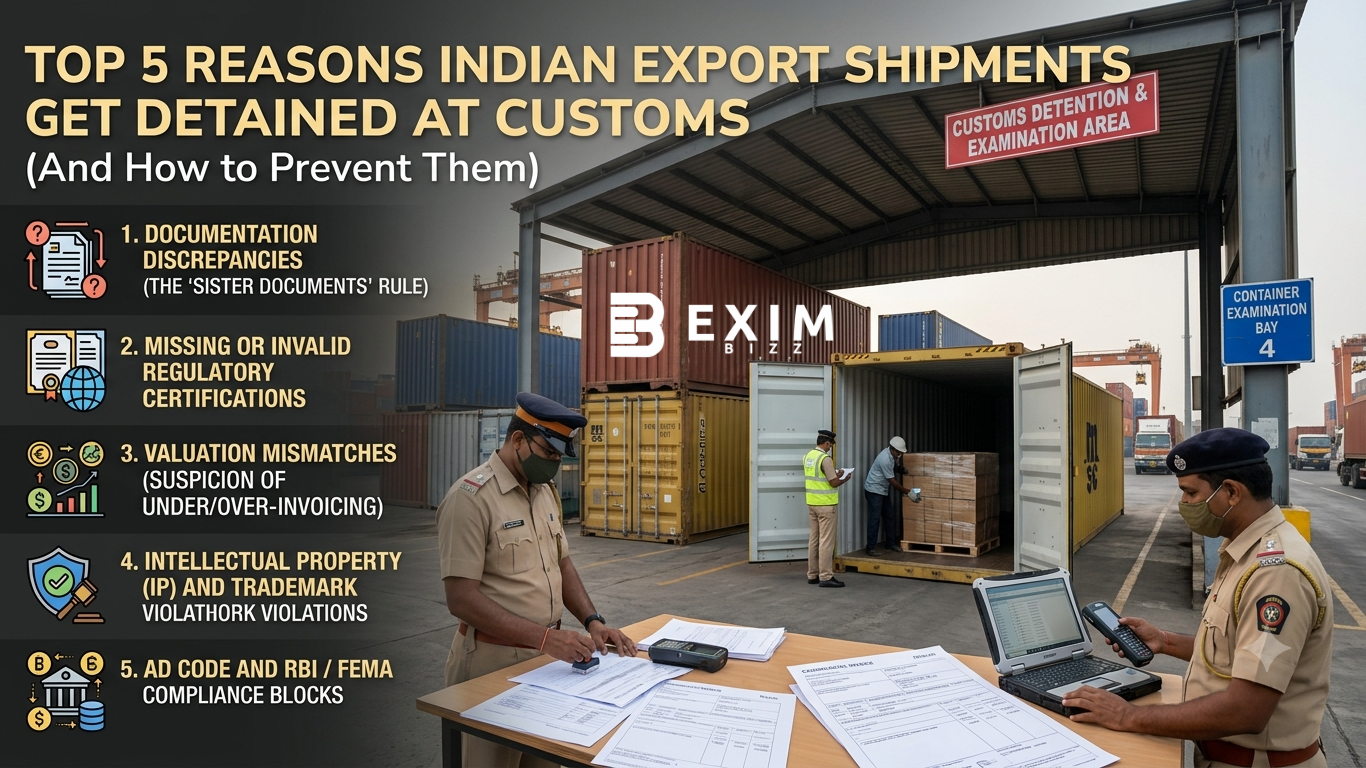
Based on years of logistical experience, here are the top 5 reasons Indian export shipments get detained, and the exact steps you must take to prevent them.
1. Documentation Discrepancies (The “Sister Documents” Rule)
The number one reason for customs detention is a mismatch in paperwork. Customs officers use automated systems to cross-check your documents. If the data doesn’t align perfectly, the system flags the shipment for a manual check.
The Common Mistakes:
The Gross Weight on the Packing List doesn’t match the Weighment Slip from the port.
The HS Code on the Commercial Invoice differs from the HS Code on the Shipping Bill.
The quantity mentioned in the invoice doesn’t match the physical count during a random examination.
🛡️ How to Prevent It:
The 100% Match Rule: Ensure your Commercial Invoice, Packing List, Shipping Bill, and Bill of Lading are “sister documents.” The invoice number, date, weights, quantities, and HS codes must be identical across all of them.
Pre-Submit Audit: Before your Customs House Agent (CHA) files the Shipping Bill, ask to review the draft. Check every single digit.
2. Missing or Invalid Regulatory Certifications
Depending on your product, Indian Customs and the destination country require specific Quality Control Certificates. If these are missing, expired, or not uploaded to the ICEGATE portal, the goods will not move.
The Common Mistakes:
Exporting agricultural products without a valid Phytosanitary Certificate.
Exporting electronics to Europe without the CE Marking compliance declaration.
Exporting food or pharma to the US without FDA prior notice and registrations.
Ignoring India’s domestic Quality Control Orders (QCOs) that require BIS certification for certain steel, chemical, or textile products before they can be exported.
🛡️ How to Prevent It:
Create a Compliance Matrix: For every product you export, create a checklist of required certificates for both the Indian export side and the destination import side.
Upload to ICEGATE: Ensure your CHA has uploaded the digital copies of these certificates to the ICEGATE system along with the Shipping Bill.
3. Valuation Mismatches (Suspicion of Under/Over-Invoicing)
Indian Customs maintains a massive, historical database of export prices (the Export Import Data Bank). If your declared export value is significantly lower or higher than the historical average for that specific HS Code, the system will flag it.
The Common Mistakes:
Under-invoicing: Declaring a lower value to help the buyer evade import duties in their country (which is illegal and can lead to severe penalties).
Over-invoicing: Declaring a higher value to illegally claim higher duty drawbacks or route money out of the country.
Sample Shipments: Declaring a high value for “free samples” without marking them as “Value for Customs Purpose Only – Not for Sale.”
🛡️ How to Prevent It:
Price Justification: If you are exporting at a premium price (due to high quality) or at a discount (to clear old stock), keep a documented trail of emails with the buyer justifying the price.
Be Transparent: If your price is genuinely different from the market average, proactively provide a technical specification sheet to customs to prove why your product commands that price.
4. Intellectual Property (IP) and Trademark Violations
Customs is actively on the lookout for counterfeit goods. If you are exporting goods that feature a registered brand name, logo, or patented design, and you do not have explicit authorization, your shipment will be seized.
The Common Mistakes:
Exporting unbranded goods that accidentally feature a protected design or logo.
Acting as a merchant exporter for a branded product without having the brand owner’s “No Objection Certificate” (NOC) registered with customs.
🛡️ How to Prevent It:
Trademark Search: Before launching a new product, do a quick search on the destination country’s trademark database.
Get it in Writing: If you are manufacturing for a global brand, ensure their authorization letter is explicitly mentioned in your shipping documents and registered with Indian Customs.
5. AD Code and RBI / FEMA Compliance Blocks
This is a uniquely Indian hurdle. Even if your physical goods and documents are perfect, your shipment can be blocked at the digital gateway if your banking compliance isn’t updated.
The Common Mistakes:
Unregistered AD Code: Your Authorized Dealer (AD) Code from your bank must be digitally registered on the ICEGATE portal for every specific port you ship from. If you usually ship from Nhava Sheva but suddenly ship from Mundra without registering the AD Code there, the Shipping Bill won’t generate.
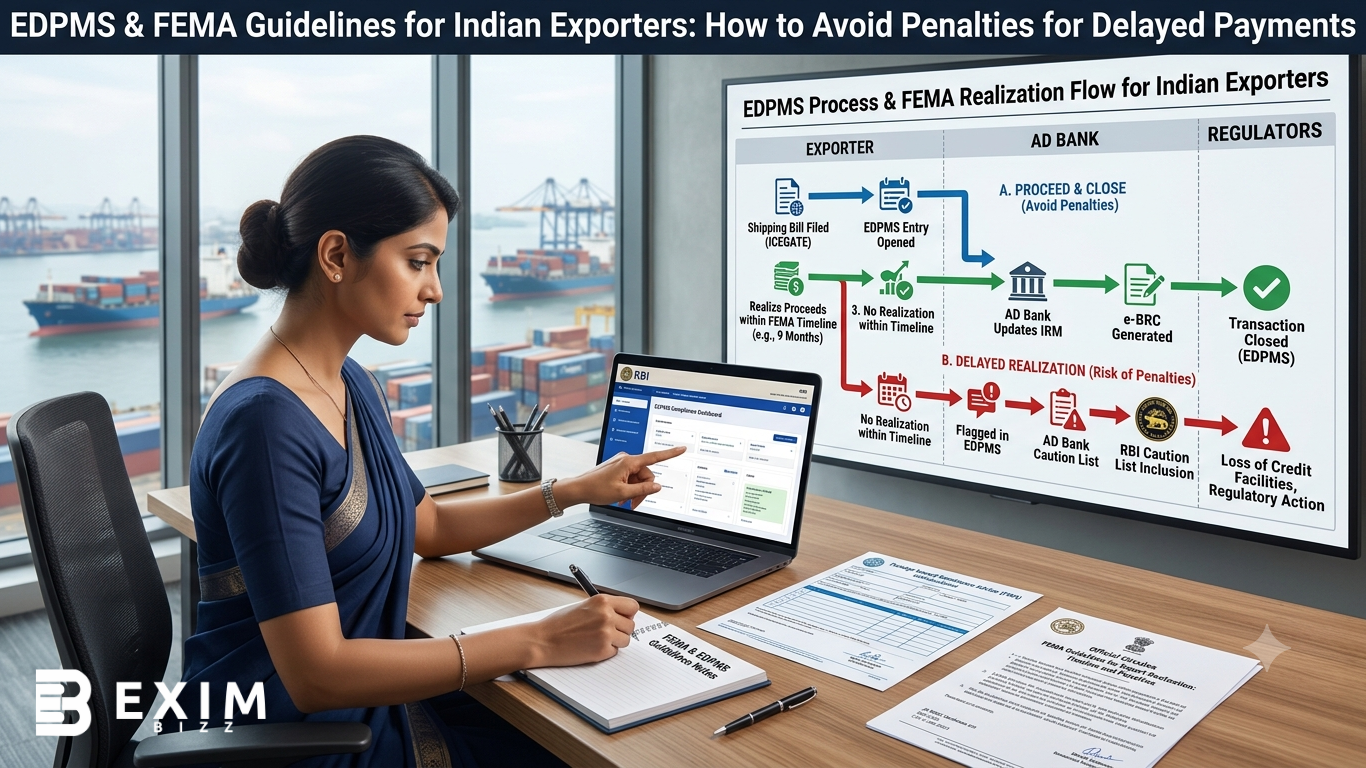
Pending EDPMS Entries: If you have past shipments where the foreign payment hasn’t been realized and closed in the RBI’s EDPMS (Export Data Processing and Monitoring System) within the mandated timeframe, the bank may block new shipments.
🛡️ How to Prevent It:
Port-Wise AD Code: The moment you decide to ship from a new port, get the AD Code registration letter from your bank and have your CHA register it on ICEGATE immediately.
Monthly EDPMS Reconciliation: Sit with your bank’s forex department on the 1st of every month. Ensure all past export payments are realized and the EDPMS entries are closed (knocked off).