
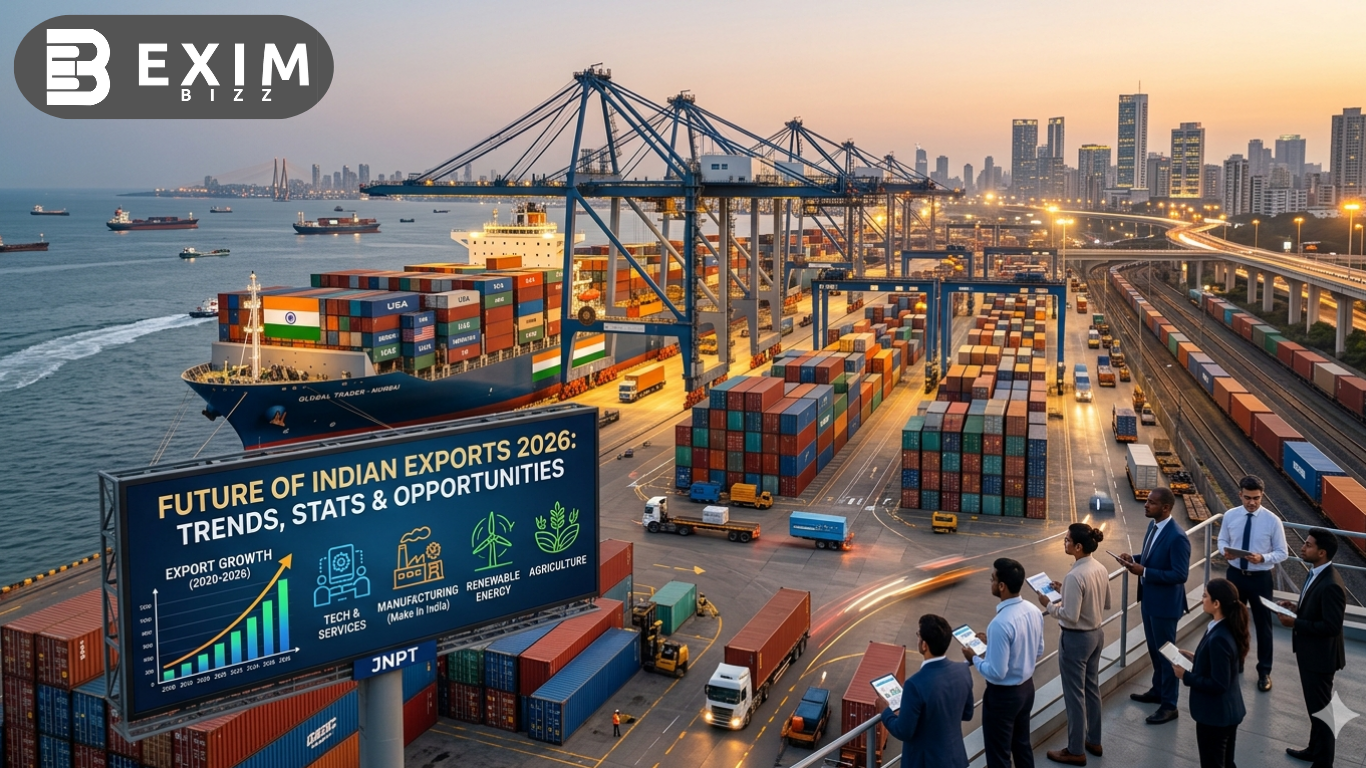
India’s export story has shifted from incremental growth to strategic transformation. What once relied on cost arbitrage and traditional commodities is now powered by technology, policy alignment, and global supply chain realignment. As we move through 2026, Indian exporters are no longer just participants in global trade—they are becoming architects of it. But what’s driving this shift? Which sectors are leading the charge? And how can businesses position themselves to capture the next wave of international demand? In this comprehensive guide, we break down the latest export performance data, emerging trends, high-growth opportunities, and the tech tools that will define India’s trade trajectory in the years ahead.
📊 FY 2025-26 Export Performance: By the Numbers
According to provisional data from the Ministry of Commerce & Industry and DGFT, India’s export engine continued its upward trajectory in FY 2025-26:
- Total Merchandise Exports: ~$492 Billion (up 6.8% YoY)
- Services Exports: ~$385 Billion (driven by IT, GCCs, engineering R&D, and digital services)
- Overall Export Growth: ~7.1% despite global headwinds and shipping volatility
- Key Growth Drivers: Electronics manufacturing, specialty chemicals, pharmaceutical formulations, renewable energy components, and defense exports
- New Market Penetration: 22% increase in exports to Africa, 18% to Latin America, and 15% to ASEAN compared to FY 2023-24
These figures reflect India’s successful navigation of geopolitical shifts, the maturation of Production Linked Incentive (PLI) schemes, and deeper integration into regional FTAs. With the government’s roadmap targeting $1 trillion in combined merchandise and services exports by 2030, the FY 2025-26 performance serves as both a milestone and a Launchpad.
📦 Top Exported Products from India (FY 2025-26)
India’s export basket has diversified significantly, moving beyond traditional reliance on a few high-value sectors. The top-performing categories include:
- Engineering Goods & Capital Machinery: ~$118B | Industrial equipment, auto components, and precision tools
- Petroleum Products & Refined Fuels: ~$89B | High-value refined exports to Europe, Africa, and Asia
- Gems & Jewelry: ~$42B | Cut & polished diamonds, lab-grown diamonds, and gold jewelry
- Pharmaceuticals & Medical Devices: ~$38B | Generic medicines, vaccines, surgical equipment, and diagnostics
- Electronics & Mobile Phones: ~$35B | Smartphone assembly, semiconductors packaging, and consumer electronics
- Chemicals & Petrochemicals: ~$32B | Specialty chemicals, agrochemicals, and polymers
- Textiles & Apparel: ~$28B | Technical textiles, ready-made garments, and sustainable fabrics
- Agricultural & Marine Products: ~$26B | Basmati rice, spices, buffalo meat, shrimp, and processed foods
Notably, lab-grown diamonds, EV components, drone systems, and Ayurveda/wellness products emerged as breakout categories, registering double-digit growth and attracting sustained international buyer interest.
🔮 Key Trends Reshaping Indian Exports in 2026+
- Digital Trade & Paperless Exports
The transition to fully digital trade documentation is accelerating. ICEGATE 2.0, e-Sanchit, and blockchain-based e-BLs are reducing clearance times by 40-60%. Cross-border e-commerce exports alone grew by 34% YoY, with platforms like Amazon Global Selling, Flipkart Wholesale, and Shopify enabling MSMEs to reach D2C buyers overseas.
- AI & Predictive Supply Chains
Exporters are leveraging AI for demand forecasting, dynamic pricing, and route optimization. Tools that analyze port congestion, freight rate volatility, and buyer payment behavior are now standard for mid-to-large exporters. Machine learning models are also helping businesses comply with evolving standards like EU’s CBAM and US FDA traceability rules.
- Sustainability as a Trade Requirement
Green compliance is no longer optional. Carbon footprint tracking, recycled packaging mandates, and ESG reporting are becoming baseline expectations in EU, North American, and Japanese markets. Indian exporters investing in solar-powered warehouses, water-efficient processing, and certified supply chains are winning preferential contracts.
- FTAs & Strategic Trade Corridors
The India-Middle East-Europe Economic Corridor (IMEC), India-UAE CEPA, India-Australia ECTA, and ongoing India-EU/UK negotiations are reducing tariff barriers and simplifying rules of origin. Exporters who understand FTA utilization, cumulation rules, and preferential certification are capturing 15-25% higher margins.
- Nearshoring & Friendshoring Realignment
Global buyers are diversifying away from single-source dependencies. India’s political stability, English-speaking workforce, and manufacturing scale make it a preferred alternative. Sectors like electronics assembly, pharmaceutical intermediates, and defense components are seeing multi-year supply contracts from Western and Asian buyers.
🌍 Emerging Opportunities for Indian Exporters
| Sector | Why It’s Growing | Target Markets |
| Renewable Energy Components | Global decarbonization push | EU, USA, Middle East, Australia |
| Specialty & Green Chemicals | Replacement of Chinese supply | Germany, Japan, South Korea |
| Defense & Aerospace | Indigenous manufacturing push | Southeast Asia, Africa, Gulf |
| Agri-Tech & Processed Foods | Rising global food security focus | USA, UK, GCC, Japan |
| Digital & Creative Services | AI, animation, gaming, SaaS | North America, Europe, LatAm |
MSMEs are particularly well-positioned to capitalize on these opportunities by partnering with export consultants, leveraging government credit guarantees, and participating in targeted trade delegations.
🛠️ How Exporters Can Future-Proof Their Business
- Audit Your FTA Readiness: Map your HS codes against active FTAs. Many exporters leave 8-12% margin on the table by not claiming preferential tariffs.
- Digitize Documentation: Adopt e-invoicing, digital RCMC tracking, and automated customs filing to reduce errors and delays.
- Build Compliance-First Processes: Invest in product certifications (CE, FDA, REACH, BIS, GMP) before market entry. Compliance isn’t a cost—it’s a competitive moat.
- Diversify Buyer Portfolios: Reduce dependency on single markets. Use B2B platforms, virtual trade fairs, and government-backed delegations to build multi-region pipelines.
- Partner Strategically: Work with export consultants who understand market-specific regulations, logistics optimization, and buyer negotiation dynamics.
🚀 The Road Ahead
The future of Indian exports isn’t about volume alone—it’s about value, velocity, and visibility. With technology lowering entry barriers, policy frameworks aligning with global standards, and Indian manufacturers earning trust for quality and reliability, the next decade belongs to exporters who adapt quickly, comply proactively, and scale intelligently.
At Eximbizz, we help Indian businesses transform export complexity into competitive advantage. From RCMC facilitation and FTA utilization to market entry strategy and end-to-end compliance, our consultancy is built for the realities of global trade in 2026 and beyond.